Owls: The Owl That Adapted to Life Across the World

What is in this article?

When people think about owls, they think about a bird that comes out at night, quiet and hard to see. But there is something more interesting about owls, especially the barn owl. It is one of the most widespread birds in the world.
This brings up a simple question: How did a bird that does not migrate manage to spread across the world? The answer is not migration. It is time and slow movement.
Barn owls do not travel long distances every year like some other birds. Instead, they move through a process called dispersal. Young owls leave where they were born and settle in nearby areas. The next generation does the same thing. Over many years, this slow movement continues.
One owl does not cross a continent. But many generations, moving step by step, can.
Another reason for their success is that they can live in many different places. Barn owls are found in:
Farmlands
Grasslands
Forest edges
Around human settlements
As long as there is food, especially small mammals, they can survive. This makes it easier for them to keep spreading into new areas.
Even though barn owls look very similar around the world, they are not exactly the same everywhere. As we mentioned, over time, groups became separated by oceans and long distances. Because they do not mix, they started to change in small ways.
This is why scientists sometimes divide them into:
The Western Barn Owl (Tyto alba)
The Eastern Barn Owl (Tyto javanica)
The American Barn Owl (Tyto furcata)
These differences are small and not always easy to see in the field. In many cases, they still look like the same bird. But research shows these populations have been evolving separately for a long time.
What do owls eat?
Owls are mainly nocturnal hunters and feed largely on small mammals, especially rodents such as rats and mice, though they may also take small birds, insects, and reptiles when available. By preying on rodents, they provide a valuable natural pest-control service, particularly in farming communities where they help reduce crop damage and limit the spread of rodent-borne diseases.
Barn owls, in particular, feed primarily on small mammals, such as mice and rats. Depending on what is available locally, they may also take shrews and small bats, and occasionally small birds, frogs, lizards, or large insects.
Distribution of The Western Barn Owl

The map shows that records of the Western Barn Owl are concentrated across the “Old World,” with the densest clusters in western and central Europe and around the Mediterranean.
From there, sightings extend east through parts of the Middle East into South Asia, and south across much of Africa, with especially heavy coverage in southern Africa and notable clusters in East Africa and Madagascar. In contrast, there are few to no records shown in the Americas, highlighting that this species’ documented distribution is primarily across Europe, Africa, and parts of Asia.
Distribution in Ghana, West Africa
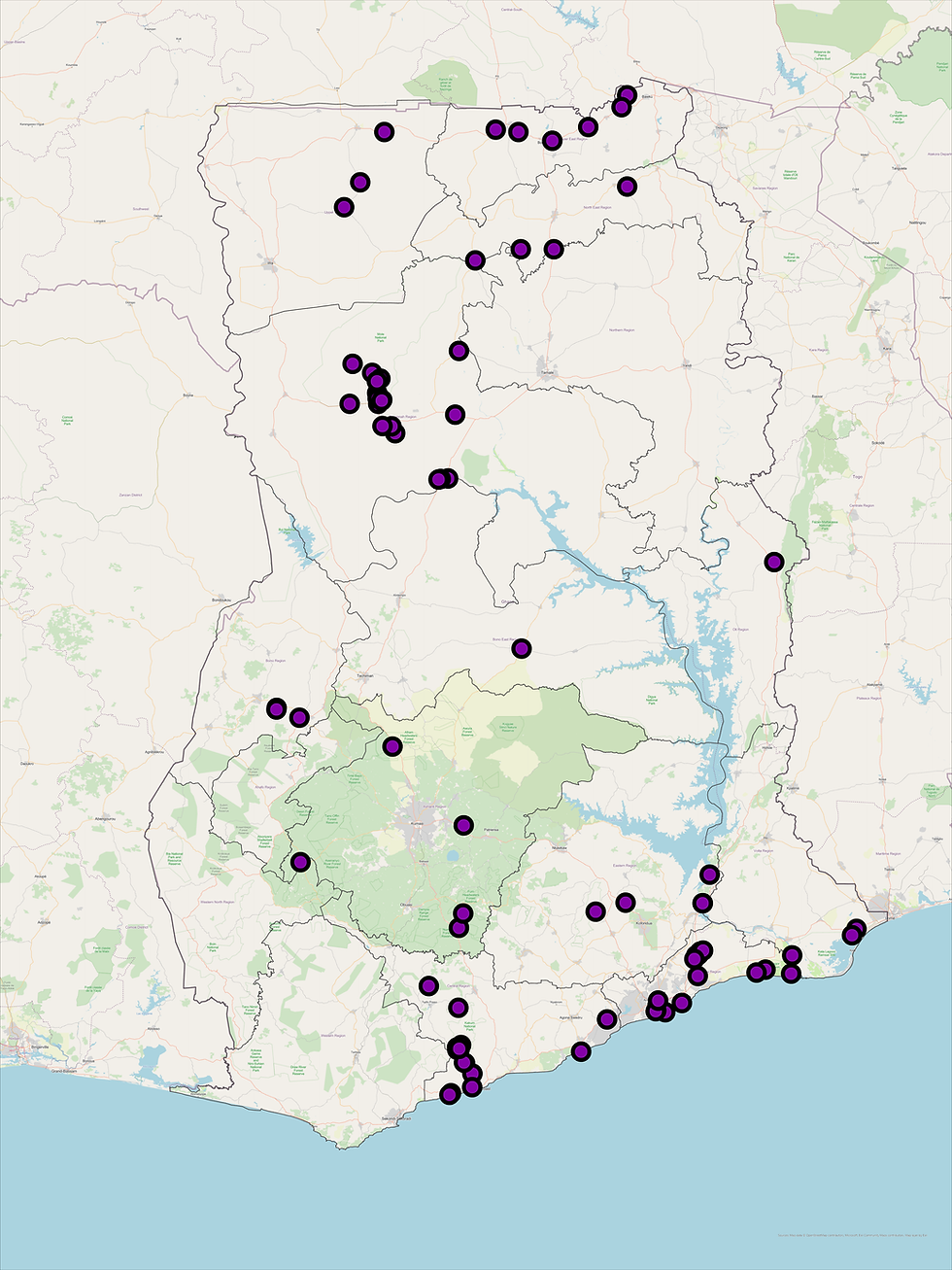
In Ghana and the wider West African region, the map shows the Western Barn Owl occurring in scattered pockets rather than as one continuous, densely recorded range. Records are present across the coastal belt and into the interior, suggesting the species is broadly distributed where suitable open habitats exist, such as farmland, grassland, and savanna, often close to towns and villages that provide nesting and roosting sites.
Overall, the pattern for Ghana indicates a widespread but locally variable presence, with fewer mapped records than in parts of Europe and southern Africa, which may reflect both lower survey coverage and more patchy reporting rather than true absence.
Seasonal Presence of The Western Barn Owl in Ghana
Western Barn owls are generally considered year‑round residents in Ghana, not seasonal migrants, so they can be present and heard in any month.
That said, how often you hear them isn’t constant through the year:
More vocal periods: typically around breeding (courtship and territory defence) and when adults are feeding chicks, when calling activity increases at night.
Quieter periods: outside breeding, they can still be around but call less, and their activity is easier to miss.
So, yes, they can be heard year‑round, but you’re more likely to notice/hear them in certain periods rather than evenly across the whole year.
Western barn owls in the Western parts of Africa don’t have a single, fixed “spring” breeding season the way they do in temperate regions. Breeding is usually opportunistic and tends to line up with periods when prey (especially rodents) is abundant, which is often during and shortly after the rainy seasons.
What that typically means in practice:
Timing: nesting can occur in different months depending on local rainfall and food supply. Many pairs are most likely to start breeding after rains, when vegetation and insect activity increase and rodent numbers rise.
Flexibility: pairs may skip breeding in poor food years, or breed earlier/later than expected if prey booms.
Vocal activity: you’re most likely to hear them more often at night during courtship and early nesting (more calling, more territorial displays), and again when adults are actively feeding chicks.
Nest sites in Ghana: commonly buildings (churches, schools, warehouses), roof spaces, old structures, and sometimes tree cavities or cliff/rock openings, places that stay dry and undisturbed.
Clutch and development (general barn owl pattern): usually several eggs laid a few days apart; incubation is about a month, and young remain dependent for weeks after fledging. So a single breeding attempt can keep a site active for 2–3+ months.

Sources of Data: