Where do kingfishers nest? Distribution of the Blue-Breasted Kingfisher

What is in this article?

Kingfishers are among the most striking birds in the world, and there are over 100 species globally, belonging to the family Alcedinidae. These birds are widely distributed across tropical and temperate regions, with the highest diversity found in Africa, Asia, and Oceania. Africa alone supports more than 30 species, ranging from riverine specialists to forest-dwelling kingfishers that rarely interact with water.
Despite their name, not all kingfishers eat fish. While some species are closely tied to rivers and wetlands, many others live in woodlands and forests where they feed on insects, amphibians, and small vertebrates. What unites them is their distinctive body structure, large heads, long dagger-like bills, short legs, and compact tails, adapted for precision hunting from a perch.
Where do kingfishers nest?
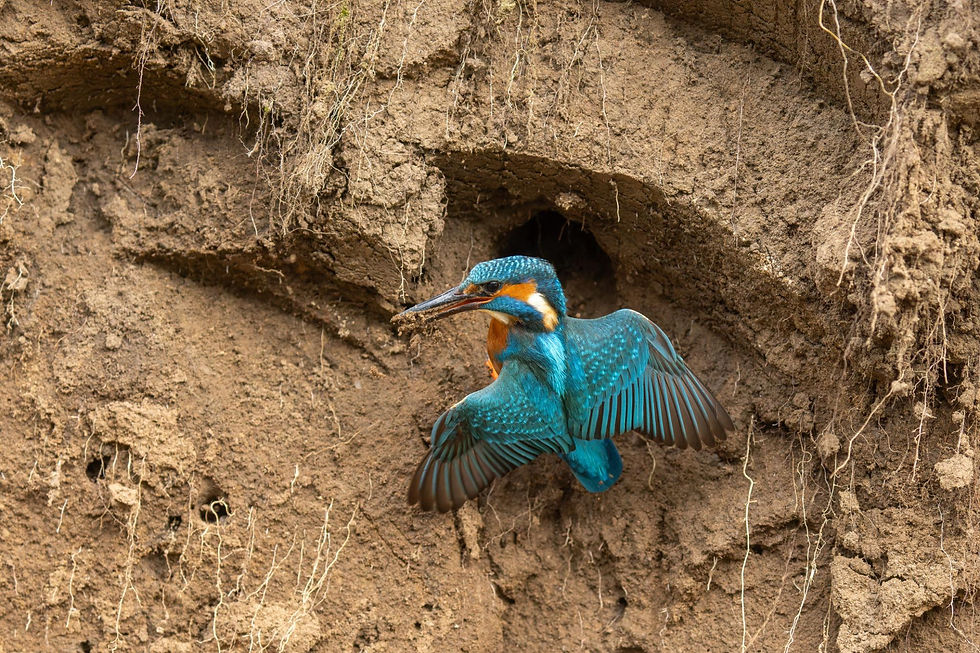
Kingfishers are cavity nesters, and their nesting strategy is one of the most fascinating aspects of their ecology. Most species excavate horizontal tunnels into soft substrates such as riverbanks, earth embankments, or sandy soils. These tunnels can range from about 30 cm to over 1 metre long, ending in a chamber where the eggs are laid. Both males and females usually participate in digging the nest, using their bills and feet. The eggs are typically white and rounded, laid directly on the bare substrate without any nesting material.
However, not all kingfishers nest in the ground:
Some species use tree cavities or rotten wood
Others, especially forest kingfishers, nest in arboreal termite mounds
A few adapt to artificial structures or embankments
This diversity in nesting reflects their wide ecological range.
Example: Blue-breasted Kingfisher
The Blue-breasted kingfisher is a good example of how flexible kingfisher nesting can be.
It is widely found across Equatorial Africa, inhabiting dense forests, riverine woodlands, and other well-wooded habitats. Unlike many riverbank-nesting species, it typically nests in holes within tree termite mounds, rather than digging into soil banks. This highlights an important point: kingfisher nesting is not strictly tied to water, especially for forest species like the Blue-breasted Kingfisher.
Blue Kingfisher: Distribution and Behaviour
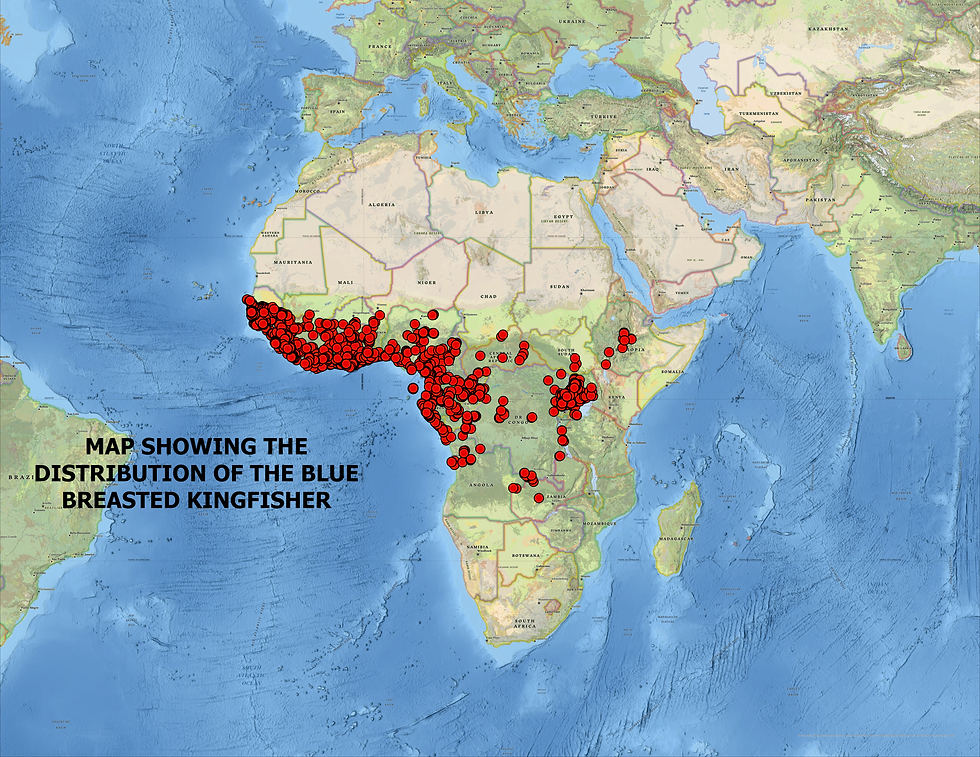
Understanding where a species occurs is one of the most direct ways to understand how it survives. The distribution map of the Blue-breasted Kingfisher reveals more than scattered observation points; it tells a clear ecological story shaped by forests, water, and climate across sub-Saharan Africa.
A Forest-Dependent Distribution
The most striking pattern on the map is the dense concentration of records in West and Central Africa. Countries along the Upper Guinean and Congo forest blocks, stretching from Sierra Leone through Ghana and Nigeria into Cameroon and the Democratic Republic of Congo, form the core of the species’ range.
This is not coincidental. The Blue-breasted Kingfisher is a forest specialist, closely associated with:
Lowland tropical rainforest
Gallery forests along rivers
Dense, moist woodland habitats
These environments provide the shaded perches, prey availability, and nesting conditions the species depends on. As a result, its distribution closely mirrors the extent of Africa’s humid forest belt.
Absence Speaks Volumes
Equally important are the areas where the species is largely absent. The map shows very few records across:
The Sahel region
North Africa
Much of southern Africa’s drier zones
These gaps highlight a key ecological constraint: the species does not tolerate dry, open, or sparsely vegetated landscapes. Unlike some kingfishers that thrive in savannas or open wetlands, the Blue-breasted Kingfisher is tightly bound to closed-canopy systems and consistent moisture.
East Africa: A Fragmented Extension
In East Africa, the distribution becomes more scattered. Records appear in parts of Uganda, Kenya, and Tanzania, but they are noticeably less dense.
This suggests that populations in this region are:
Localised rather than continuous
Confined to riverine forests and isolated forest patches
Likely influenced by habitat fragmentation
Rather than representing a stronghold, East Africa marks the edge of the species’ ecological comfort zone.
Southern Limits of the Range
The map also shows occasional records further south, particularly in countries such as Zambia and Angola. These occurrences are sparse and likely tied to:
Pockets of suitable wet forest habitat
Seasonal or localised environmental conditions
At these southern limits, populations are expected to be less stable and more habitat-dependent, reinforcing the species’ reliance on specific ecological conditions.
Seasonal Presence: Movement Without Migration
One of the most important aspects of the Blue-breasted Kingfisher’s ecology is how it responds to seasonal change.
Unlike long-distance migratory birds, this species is largely resident. However, it does exhibit short-range seasonal movements driven by environmental conditions.
During the wet season:
Habitat availability expands as water becomes more widespread
Birds may move into newly suitable areas
Increased activity during breeding makes them more detectable
In the dry season:
Individuals retreat to permanent water sources and dense forest refuges
Visibility decreases, even if birds remain present
This pattern reflects ecological flexibility within a limited range, rather than true migration.
Conservation Implications
At first glance, the wide distribution of the Blue-breasted Kingfisher may suggest that it is secure. However, the map tells a more nuanced story. The species depends heavily on tropical forests, particularly in West and Central Africa, regions currently facing intense pressure from:
Deforestation
Agricultural expansion
Illegal mining activities
As these habitats shrink and fragment, populations may become increasingly isolated. This means that despite its broad range, the species could face long-term declines if forest loss continues.